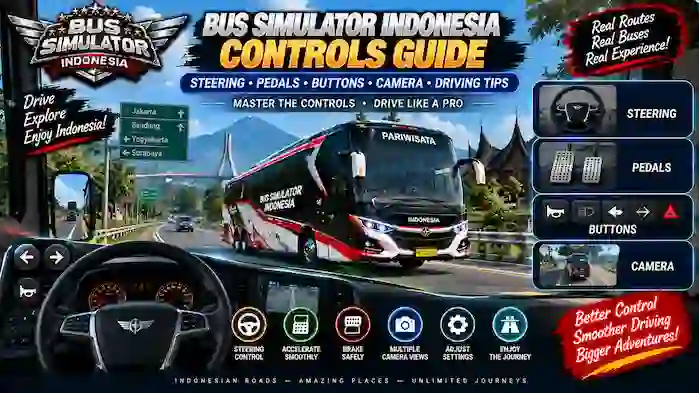
Learning the Bus Simulator Indonesia controls is an important step for beginners who want to drive smoothly and confidently. BUSSID offers several controls for steering, acceleration, braking, camera movement, and other driving actions.
New players may initially find the controls confusing, especially when switching between different control options. Understanding what each button does and choosing a comfortable control method can make driving easier.
This guide explains the main BUSSID controls, including steering, buttons, pedals, camera controls, braking, and useful driving tips for beginners.
Understanding BUSSID Controls
The controls in Bus Simulator Indonesia are designed to give players control over different parts of the driving experience.
Depending on the current game version and selected settings, you may interact with controls for:
- Steering
- Acceleration
- Braking
- Camera
- Horn
- Indicators
- Lights
- Doors
- Other vehicle functions
The exact appearance and position of controls can vary depending on the game settings and version.
Steering Controls

Steering is one of the most important parts of BUSSID driving.
Players may have different steering options depending on the available settings. A steering wheel interface can provide a more traditional simulation-style experience, while other control methods can be easier for beginners.
Steering Wheel
The virtual steering wheel lets you turn the bus by moving the wheel left or right.
It can provide precise control once you become familiar with it, but beginners may need some practice to make smooth turns.
Button Steering
Button-based steering uses left and right controls.
This method can be simpler because you only need to tap the direction you want the bus to move.
Tilt or Motion Controls
Some mobile driving games may provide motion-based steering options depending on the device and game version.
If available, this can feel natural, but it may require more space and careful calibration.
Acceleration and Pedals
The accelerator controls the bus’s forward movement.
A common beginner mistake is pressing the accelerator too aggressively. Smooth acceleration can make it easier to maintain control, especially when leaving a bus stop or entering a busy road.
The brake pedal is equally important and should be used gradually whenever possible.
Good pedal control helps with:
- Smooth starts
- Controlled speed
- Safer turns
- Comfortable stops
- Better route management
Braking Controls
Braking is essential when approaching intersections, traffic, bus stops, and sharp turns.
Instead of waiting until the last moment, begin reducing speed early.
Basic Braking Tips
- Look ahead for traffic.
- Reduce speed before sharp turns.
- Start braking before reaching a bus stop.
- Avoid sudden braking when unnecessary.
- Leave enough distance from other vehicles.
- Use controlled inputs rather than repeatedly tapping the brake.
Practicing gradual braking can make your driving feel much smoother.
Camera Controls
Camera controls allow you to change your view while driving.
Different camera perspectives can be useful in different situations.
Interior View
The interior or driver view can provide a more immersive simulation experience.
It is useful when you want to focus on the road from the driver’s perspective.
Exterior View
An exterior camera can provide a wider view around the bus.
It can be useful for checking the vehicle’s position, making turns, and enjoying the bus design.
Camera Switching
Switch between available views when necessary rather than staying with one perspective for the entire route.
A wider camera can help you understand your bus’s position, while the interior view can provide a more realistic driving experience.
Other Important BUSSID Buttons
Besides steering and pedals, BUSSID can include buttons for different vehicle functions.
Depending on your version and vehicle, these may include:
- Horn
- Headlights
- Turn indicators
- Doors
- Wipers
- Camera
- Handbrake
- Other vehicle controls
Some functions may not be available on every bus. Custom buses can also have different control layouts.
Best BUSSID Controls for Beginners
There is no single control setup that is perfect for everyone.
For beginners, the best option is usually the one that feels predictable and easy to operate.
Simple Button Steering
Button steering can be a good starting point because it requires simple left and right inputs.
Comfortable Pedal Placement
Make sure the accelerator and brake are easy to reach without accidentally pressing the wrong control.
Familiar Camera View
Start with a camera perspective that makes it easy to see the road and bus.
Moderate Sensitivity
If your version provides sensitivity settings, experiment with them gradually instead of immediately selecting extreme values.
The goal is to develop consistent control rather than finding a setup that feels perfect on the first attempt.
How to Choose the Right Steering Method
Your preferred steering method depends on your experience and playing style.
For Beginners
Button steering may be easier to learn because the inputs are straightforward.
For Simulation Fans
A virtual steering wheel can provide a more detailed driving experience.
For Players Who Like Motion Controls
If your version supports motion-based steering, you can test it and see whether it feels comfortable.
Try one method for a few routes before changing settings repeatedly. Consistency helps you build muscle memory.
BUSSID Driving Tips for Beginners
Good controls are only part of successful driving. Your driving habits also matter.
Look Ahead
Avoid focusing only on the vehicle directly in front of you. Watch the road ahead so you have time to react.
Slow Down Before Turns
Reduce speed before entering a sharp turn rather than braking heavily in the middle of it.
Keep a Safe Distance
Leave enough space between your bus and other vehicles.
Accelerate Smoothly
Gradual acceleration makes it easier to maintain control.
Practice Bus Stops
Stopping accurately at bus stops can improve your understanding of braking and vehicle positioning.
Use Indicators
When available, use turn indicators before changing direction. This also makes the simulation experience more realistic.
How to Make Smooth Turns
Large buses need more space to turn than smaller vehicles.
When approaching a turn:
- Reduce your speed.
- Check the road.
- Begin steering gradually.
- Maintain controlled acceleration.
- Complete the turn before increasing speed.
Avoid making very sudden steering movements. Smooth inputs generally make it easier to keep the bus under control.
How to Stop the Bus Smoothly
A smooth stop begins before you reach the stopping point.
Start reducing speed early and apply the brake progressively. As you get closer to the desired stopping position, adjust your braking rather than making a sudden stop.
This technique is especially useful at:
- Bus stops
- Traffic signals
- Intersections
- Toll areas
- Congested roads
With practice, you can improve both stopping accuracy and passenger comfort within the simulation.
Common BUSSID Control Problems
Beginners can experience several common control issues.
Bus Turns Too Quickly
If steering feels too sensitive, check whether your game provides steering or sensitivity adjustments.
Bus Does Not Turn Enough
You may need more steering input or a different control method.
Accidental Braking
Make sure the brake and accelerator are positioned comfortably and that you are not tapping the wrong button.
Difficult Camera View
Try another available camera perspective if the current view makes it difficult to judge the road.
Uncomfortable Controls
If the layout feels difficult, spend some time testing different available settings before starting a long route.
Practice Routine for New Players
A short practice routine can help beginners become familiar with BUSSID controls.
Start with a quiet route and practice:
- Moving forward smoothly.
- Steering left and right.
- Braking gradually.
- Making wide turns.
- Stopping at a bus stop.
- Changing camera views.
- Using indicators and other available buttons.
Once these actions become familiar, move to routes with more traffic or challenging roads.
Controls and Different Bus Mods
Custom buses can sometimes have different visual layouts or available functions.
If you are using a bus modification and a control appears different, check the documentation or information provided with that particular bus.
A modification may also behave differently depending on the BUSSID version.
For this reason, test a new bus on a simple route before using it for a longer journey.
Frequently Asked Questions
What are the main BUSSID controls?
The main controls include steering, acceleration, braking, camera controls, and various vehicle functions such as indicators, lights, doors, and the horn, depending on the game version and bus.
Which steering control is best for beginners?
Button steering can be a simple starting point because its left and right inputs are easy to understand. However, the best option depends on your personal preference.
How can I brake more smoothly in BUSSID?
Start slowing down early and apply the brake gradually instead of waiting until the last moment.
Which camera view should beginners use?
Choose the view that gives you the clearest understanding of the road and your bus position. You can switch between available views when needed.
Why does my bus turn too quickly?
Your selected steering method or sensitivity may make the bus feel difficult to control. Check the available control settings and experiment gradually.
Final Thoughts
Understanding the Bus Simulator Indonesia controls can make the game much easier for beginners. Steering, acceleration, braking, camera movement, and vehicle buttons all play an important role in creating a smooth driving experience.
Start with simple controls, practice on easier routes, and gradually develop better steering and braking habits. Once you become comfortable with the basic controls, you can experiment with different camera views and control settings.
The most important tip is to focus on smooth inputs rather than sudden movements. With regular practice, you can become more comfortable with BUSSID’s driving system and handle longer and more challenging routes with greater confidence.